


Cart is empty


Save 28%
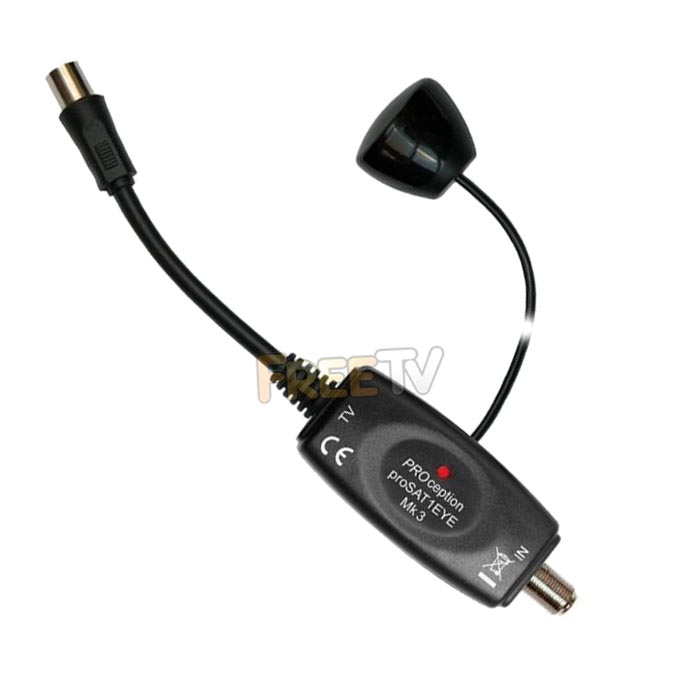

DESCRIPTION of Sky Magic Eye
- Sky Magic Eye
- Infrared Satellite Control Eye
- Colour: Grey
- Connections:
- Input: F-Joiner
- Output: Coaxial Connector
- Comes With Moulded 6cm RF Output Lead
- Low Power Usage
- Manufacturer: PROception
- CC 8542709099 15g Y
USES of Sky Magic Eye
- Allows the remote operation of a Sky, Sky+ or Sky HD box from another room
HOW a Sky Magic Eye Works
- It possible to turn on a 9V output on the RF2 outlet of a Sky box
- This power can be used to pass power, along with the picture output, to a second location
- This 9V is used to power the Sky eye which passes the signal back to the Sky box allowing the box to be operated from the second room
- This ability to pass back a signal is normally denoted on distribution equipment as 'having a return path'
ADVANTAGES of Sky Magic Eye
- Allows the remote operation of the Sky box
- Normally operates very well
- Very inexpensive option
- Can be used in conjunction with link amplifiers and certain distribution amplifiers to work a number of sky magic eyes off a single Sky box
DISADVANTAGES of Sky Magic Eye
- Though sky eyes are very handy, they are also extremely sensitive and prone to stop working for a range of reasons
- Common reasons would be such as the cable length being too long, bad connections or using a low quality splitter
Magic eye TV links are very useful and inexpensive but they are also prone to give a lot of problems. The nub of the issue is that the eye works off a 9V power supply given by a set top box and everything needs to be set up just right if the eye is work properly.
Stage 1: Install and test your magic eye directly off set top box
- Ensure that the box is turned on connected to the TV
- Connect the magic eye to the back to the "RF 2" outlet on the back of the box
- Press the "services" button your remote
- Select "system setup"
- Press ‘0′, ‘1′ & ‘Select" in quick succession
- From the Installer menu select ‘RF Outputs"
- Turn the RF output setting to ‘ON" and exit saving settings
- Also you can adjust the RF channel on which the signal will be broadcast
- If you are combining an aerial input into the RF output this is critical
- If the RF frequency is already being using by a TV channel it will cause interference
- Avoid this by selecting an alternative channel number from 21-69 (68 is the default)
- I generally set 35 as my default but it depends on what your local transmitter is.
- Select ‘RF Outputs"
- Exit out all the way and check to see does the magic eye now work
- The LED on your magic eye should now be lighting
This step has verified that:
- Your magic eye is in working order
- That your box is capable of supplying the necessary 9V signal to power the eye
Stage 2: Install your magic eye in the 2nd room
- Run a satellite cable (connect an existing cable) into the "RF 2" outlet on the back of the satellite box
- This cable will need to be terminated with a coax connector and a coax joiner
- In the attic, join the cable coming from the set top box to the cable feeding the additional TV
using low loss F-connectors (qty 2) and an F joiner (qty1) - For multi-room, use 2 way or 4 way link amplifiers or distribution amplifiers
- Terminate the other end of the cable in the second room with a coax connector
- Push the coax connector into the magic eye
- Push the magic eye into the back of the television
- Tune the TV into the correct frequency ie. Channel 68 (default) which corresponds to 847MHz
- Place the sensor part of the magic eye facing towards the seat which will be used by viewers
- Use your remote to change channels on the remote set top box
- INSTALLATION COMPLETE



