


Cart is empty


Save 25%
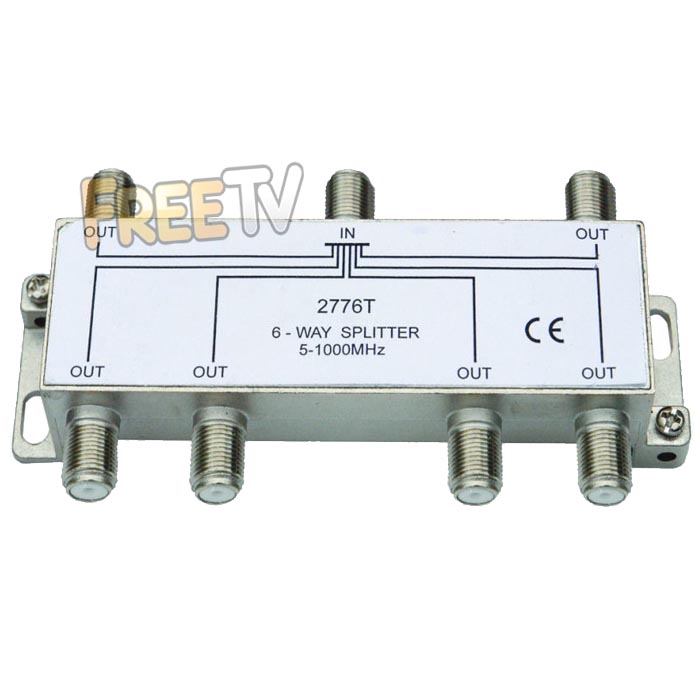

DESCRIPTION of a Passive 6 Way TV Splitter
- Inputs: 1
- Outputs: 6
- Connections: F type
- Range: 5-1000MHz
- Bands: FM / UHF / VHF
- Power passing: No
USES of a Passive 6 Way TV Splitter
- To split a TV signal to several rooms
- Split TV analogue signal to give independent viewing in several rooms
- Split output from a sky box to allow sky picture to viewed in more than one room (will not support the use of a sky eye)
ADVANTAGES of a Passive 6 Way TV Splitter
- Very effective means of splitting signal with a low level of signal loss
- Very inexpensive compared to Distribution Amplifier or power passing splitter
- Do not need power supply
- They are compact and have robust metal housing
- They are relatively easy to install
- In a good reception area they can feed the signal to at least 4 and up to 8 TVs without a significant signal loss
DISADVANTAGES of a Passive 6 Way TV Splitters
- As they do not pay power they can not be used in between a power unit and a Masthead amplifer
- By definition splitters always lead to a certain level of signal loss while a Distribution Amplifier would actually boost the signal
- Do not support the use of Sky eyes (can't carry power)
Equipment needed
- Splitters
- F type twist on connectors
Tools needed
- Snips
Procedure to Install a Passive TV Splitter
- Cut the input cable coming from the aerial so that it is long enough to reach where all the cables coming from the various rooms terminate at a single point
- Put an F connector on the cable and also on all cables feeding the various TV points which are to be connected
- Connect the aerial cable to the "IN" port on the splitter
- Connect the TV point cables to the "OUT" ports on the splitter
Summary: An F-type splitter is used to allow signal from an aerial to run to several rooms to allow independent viewing.
They come in a range of sizes 2, 3, 4, 6 and 8 way.
There are 2 basic types:
- Passive splitters: Are used to distribute un-amplified (or post amplified) signal to several rooms.
- Power passing splitters: Can be used between a power unit and the Masthead amplifier/Aerial.
- They allow the 12 volt signal from the power unit to pass through to the Masthead amplifier
- while also distributing the amplified signal on the other ports.
Main Points to remember
- Splitters are used as a simple, effective and low cost alternatives to distribution systems
- Work well when the initial signal strenght is good.
- Passive splitters will do the same job at a lower cost than power passing s for a standard unpowered system
- Power passing splitters are designed for use with power units and masthead amplifers
- Can work as (expensive) passive splitters as well
- Never use splitters in series (looped one after the other) as this will lead to high levels of signal loss
- Always use F-type splitters as IEC (Coax) splitters normally have high levels of signal loss



