


Cart is empty


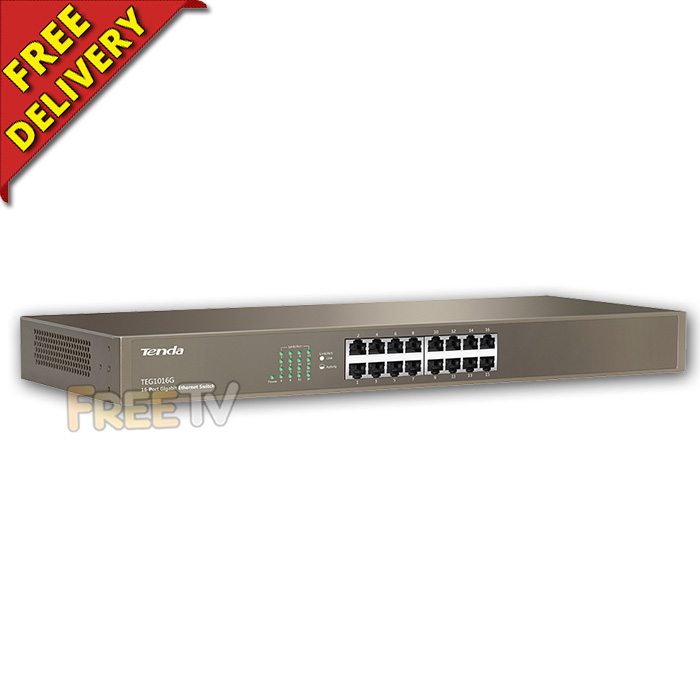

DESCRIPTION of Gigabit Network Switch
- 16 Port Gigabit Network Switch
- Type: Rack Mountable or Desktop Switch
- Unmanaged Network Switch
- Standards & Protocols
- IEEE802.3, 802.3u, 802.3ab, 802.3x
- CSMA/CD, TCP/IP
- MAC Address Auto-Learning & Auto-Aging
- IEEE802.3x Flow Control for Full-Duplex Mode & Backpressure for Half-Duplex Mode
- Back Bound Bandwidth: 16Gbps
- MAC Address Table: 4K
- Forwarding Rate
- 10BASE-T: 14880pps/Port
- 100BASE-TX: 148800pps/Port
- 1000BASE-T: 1488000pps/Port
- Transmission Method Store & Forward
- Ports: 16x 10/100/1000Mbps Auto-Negotiation RJ45 ports (Auto MDI/MDIX)
- Network Media
- 10Base-T: UTP Category 3, 4, 5 Cable (Maximum 100m)
- EIA/TIA-568 100Ù STP (Maximum 100m)
- 100Base-Tx: UTP Category 5, 5e Cable (Maximum 100m)
- EIA/TIA-568 100Ù STP (Maximum 100m)
- 1000Base-T: UTP Category 5, 5e Cable (Maximum 100m)
- LED Indicators: Power, 10/100M, 1000M
- Safety & Emission: FCC, CE
- Power: UK/IRE 3 Pin Plug
- CC 85389000 0.45kg Y
USES of Gigabit Network Switch
- Used with CAT6 cables to build high speed gigabit network
- Also backwards compatible with 10/100 networks (CAT5)
- Would be very useful in an IP camera setup also
ADVANTAGES of Gigabit Network Switch
- Is compatible with 10/100/1000 networks
- 16 ports will suffice most small networks or IP camera setups
- It is an unmanaged network switch, which is handier
- Low energy usage
- Can operate as desktop switch or rack mounted
DISADVANTAGES of Gigabit Network Switch
- May be too many ports for smaller jobs but does leave room for future expansion
Note: Now different model to video but same general specifications
No posts found



